
Before Photoshop, before digital printing, before Instagram — Bollywood posters were painted by hand, six storeys tall, by artists who could capture a hero's jawline from a blurry film still.
The Golden Age of the Hand-Painted Hoarding
From the 1940s through the 1990s, Bollywood film posters were painted on massive cloth banners and mounted outside cinemas across India. The artists — mostly anonymous, working from tiny studios in Mumbai's Dadar and Lower Parel — developed a visual language that was louder, bolder, and more emotionally honest than anything Western graphic design was doing at the time.
Saturated colours, dramatic poses, floating heads above action scenes, typography that screamed at you from across the street. These weren't subtle. They weren't trying to be. They were selling a feeling — three hours of escape — and they did it brilliantly.
How It Crossed the Water
When South Asian families settled in the UK in the 1950s and 60s, they brought their cinema culture with them. Southall's cinemas — the Dominion, the Himalaya — became cultural anchors for the Punjabi community. Hand-painted film posters appeared in shop windows along the Broadway, advertising the latest releases from Bombay.
Brick Lane had its own Bollywood poster culture too, driven by the Bangladeshi community's connection to Dhallywood and Bollywood. The poster shops there sold everything from Amitabh Bachchan prints to Shammi Kapoor lobby cards — proper collector pieces that people framed and hung at home.
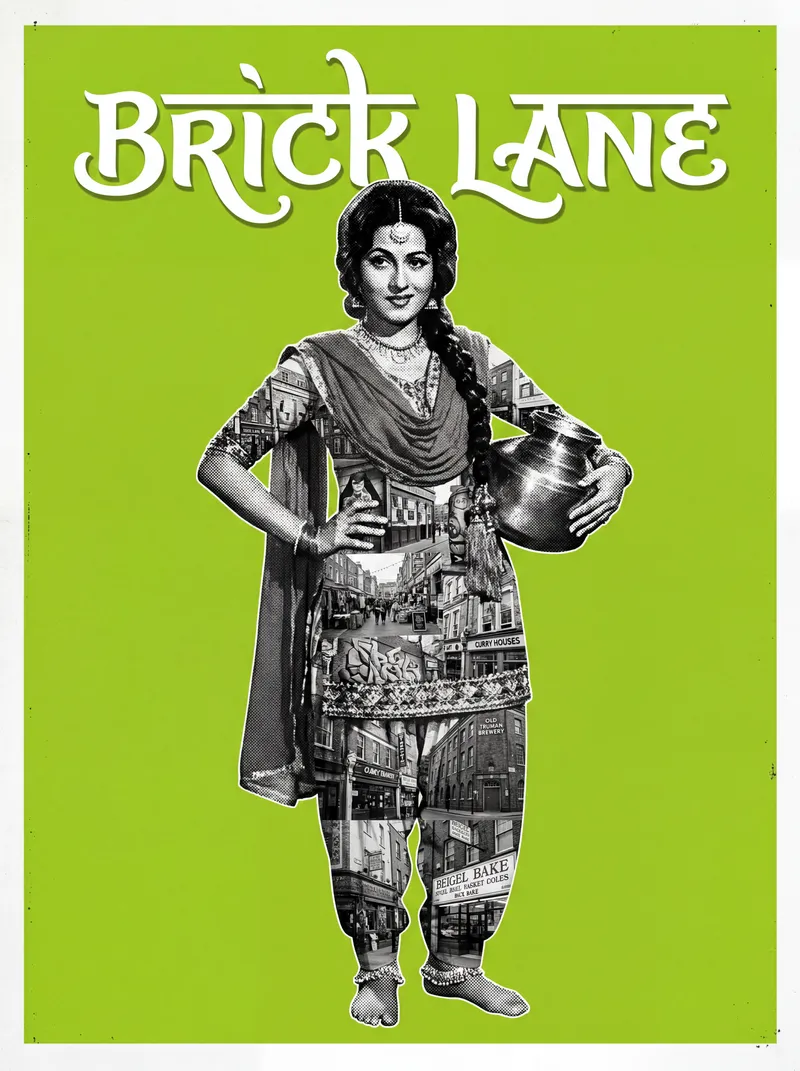
Our Brick Lane poster — the neighbourhood that brought Bollywood art to East London.
The Style Lives On
The original hand-painted hoarding artists are mostly gone — digital printing killed the trade by the early 2000s. But the aesthetic they created is more popular than ever. That saturated, slightly over-the-top, unashamedly joyful visual style has become shorthand for celebration, warmth, and cultural pride.
That's exactly what we're channelling at SpicyEditions. Our posters take UK locations — Oxford Circus, Manchester, Camden Town — and reimagine them through that Bollywood poster lens. It's not pastiche. It's a continuation of a visual tradition that was always about making ordinary places feel extraordinary.
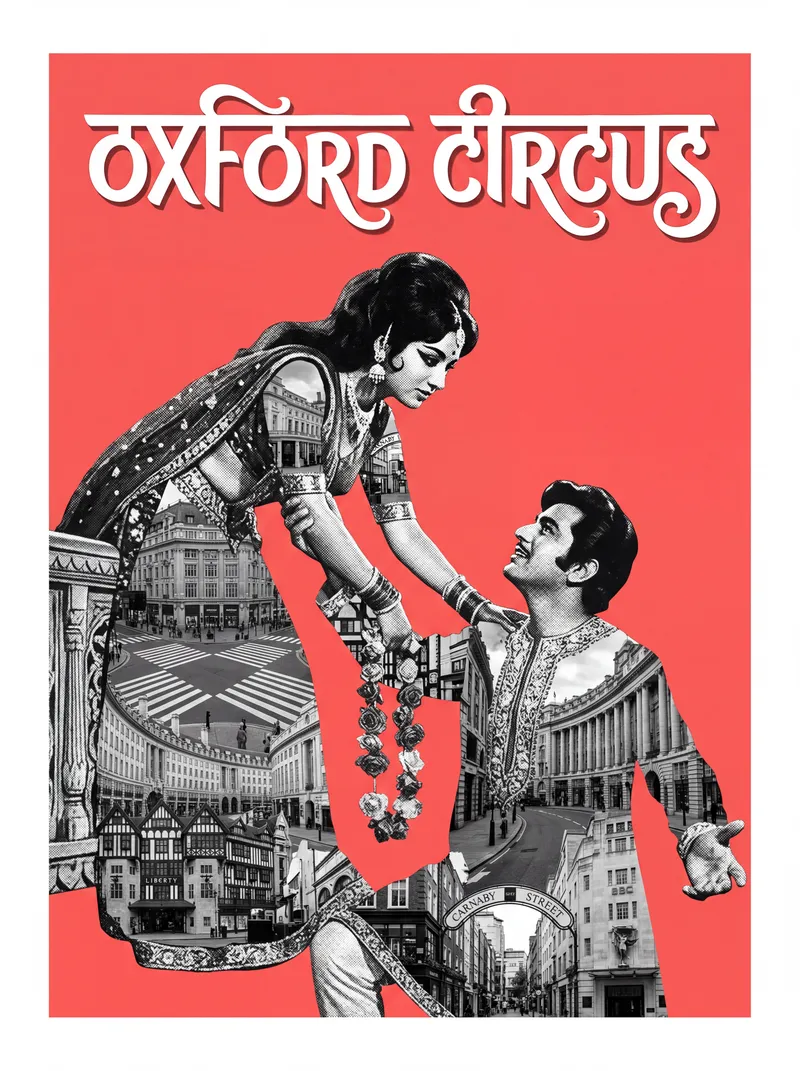
Our Oxford Circus poster — the Bollywood poster tradition applied to London's busiest junction.
Why It Matters Now
British Indian and British Pakistani culture doesn't always get wall space — literally. Most "London art" is the same monochrome skyline print from a high street chain. Bollywood-style poster art is a corrective to that. It says: this city is ours too, and we're going to represent it in our colours, our way.
The hand-painted hoarding artists of Mumbai would probably find it funny that their style ended up on living room walls in Clapham and Balham. But they'd understand the impulse. Art that makes you feel something is art that deserves to be seen.
Pro Tip: If you want to see original hand-painted Bollywood posters in person, the V&A Museum in South Kensington has a rotating South Asian design collection. The Cinema Museum near Elephant & Castle occasionally exhibits vintage Indian film ephemera too.
Are SpicyEditions posters hand-painted?
They're AI-generated in the hand-painted Bollywood style, then professionally printed on museum-quality paper. The aesthetic is faithful to the tradition — the production method is modern.
Where can I see original Bollywood poster art in London?
The V&A, the Cinema Museum, and occasionally the Barbican run exhibitions featuring Indian cinema art. Vintage poster dealers on Portobello Road and in Shoreditch sometimes carry originals too — expect to pay £200+ for authenticated pieces.