
London has more listed stations than any other transport network on the planet — over 70 of them sit on the National Heritage List, from Victorian train sheds to Charles Holden's 1920s deco circles. Each one is a small piece of cinema, and we've spent the last two years turning the best of them into Bollywood-style posters.
Why London stations work as wall art
Three reasons. One — Victorian engineers built train sheds the way cathedrals were built, with the same scale and the same drama. Two — Charles Holden's interwar Underground stations were designed by a man who treated tile, lettering, and light as one continuous problem. Three — London never tore the old ones down. You can stand on a platform in Baker Street and read brickwork from 1863 next to electric signage from 2024. That stacking is what makes the city feel like a film set, and what makes its stations sit happily inside a poster frame.
1. King's Cross
The 1852 train shed by Lewis Cubitt is still the cleanest building on the Euston Road — two great brick arches, nothing extra. The 2012 Western Concourse added a white diagrid funnel beside it, and somehow the pair get along. King's Cross is where you arrive if you're coming from the north, and where you leave for somewhere mythic. Our King's Cross poster leans into the latter. We wrote a longer piece about this station in our King's Cross spotlight.
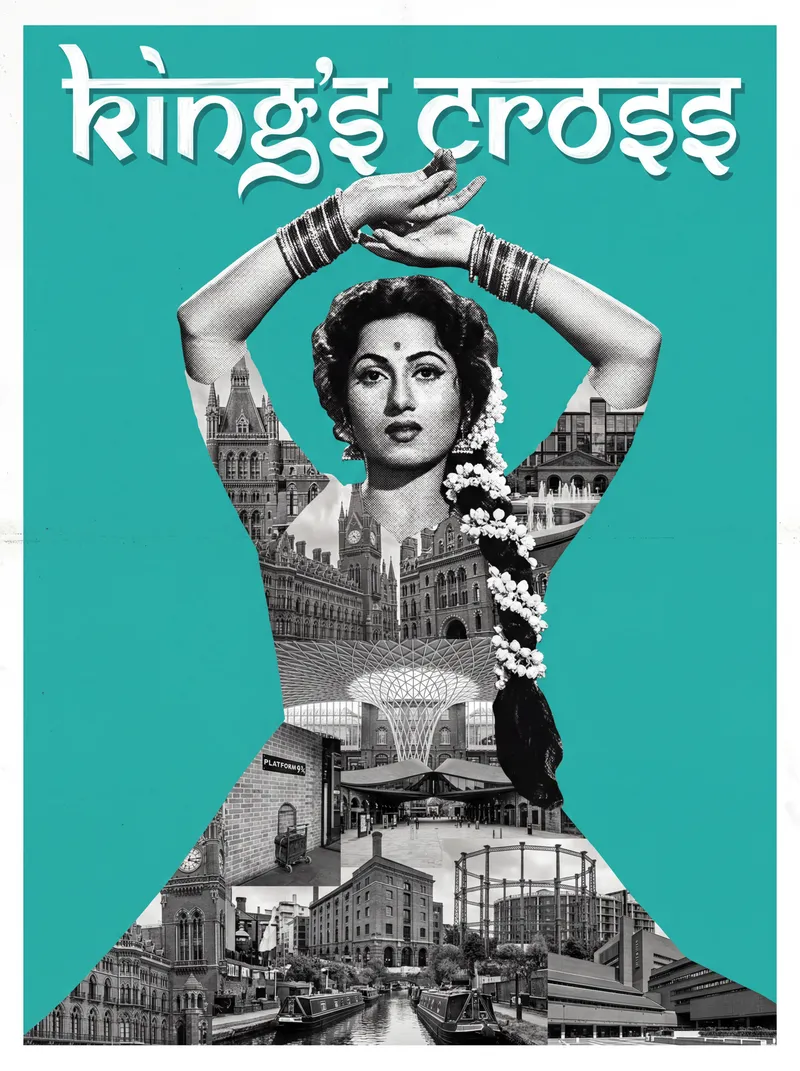
Our King's Cross poster — available framed or unframed.
2. Paddington
Brunel's 1854 train shed at Paddington is the engineering flex that no one talks about. Three wrought-iron spans, a glass roof, the original Victorian ironwork still painted in railway browns and creams. It's also Bear country, which doesn't hurt. Our Paddington poster puts that curved roof centre-frame in the gold-to-rose sky gradient lifted straight from old Bollywood lobby cards.
3. Baker Street
The oldest underground station in the world (1863) still has the original brick arches on the Metropolitan and Hammersmith & City platforms. Holmes's address, the Sherlock tile-work on the Bakerloo, the brass-and-cream signage — Baker Street wears its age well. Our Baker Street poster takes the platform vaults and the deerstalker silhouette and runs them through the saturated colour treatment of a 1970s Hindi cinema hoarding.
4. Blackfriars
Blackfriars is the only station in the world that spans a river. The 2012 rebuild kept the original 1886 cast-iron piers (you can still read the railway shields cast into them) and stretched a solar roof clean across the Thames. From the South Bank, the train looks like it's floating. Our Blackfriars poster holds the river, the sandstone shields, and the Thames sunset together in one frame.
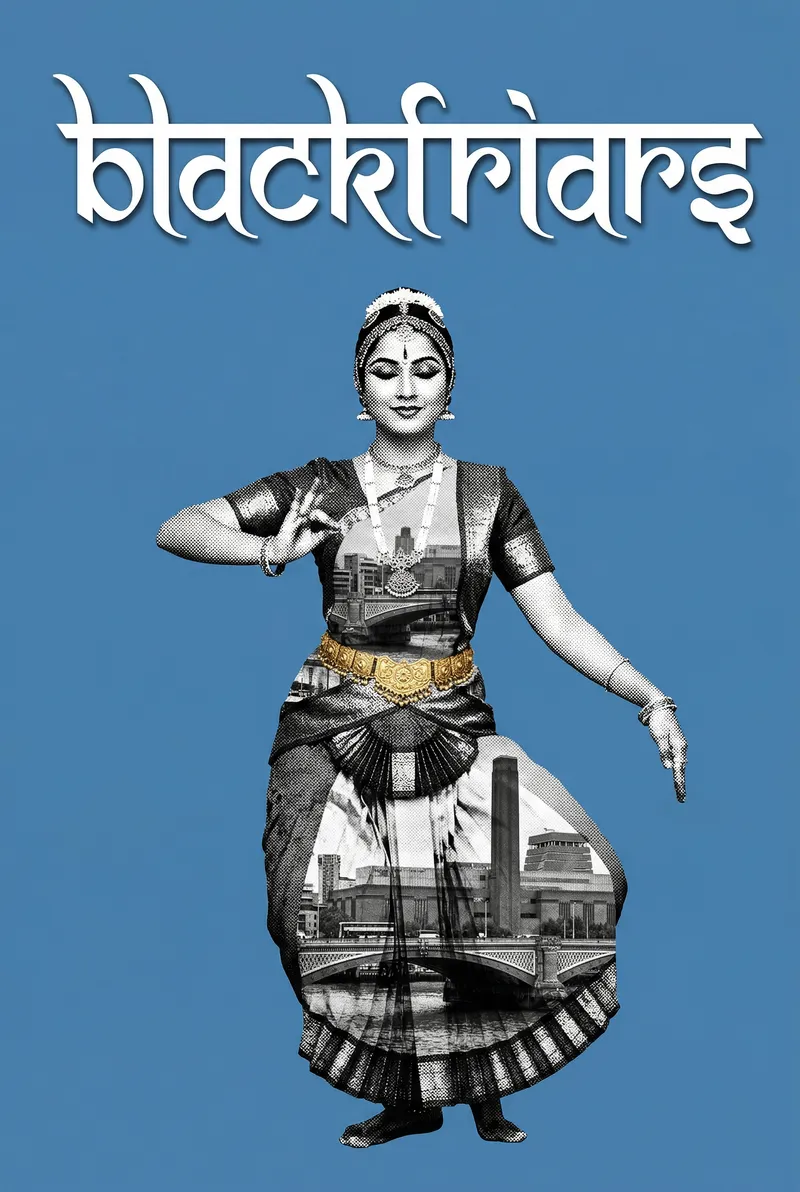
Our Blackfriars poster — the station that crosses the Thames.
5. Farringdon
Farringdon sat on the world's first underground line in 1863, and it became the busiest interchange in Britain when the Elizabeth line opened. Old Smithfield meat market is one street over. The mixture of Victorian iron and 2022 concrete cathedral works because both are unembarrassed about their own function. Our Farringdon poster frames the station against the market roofs and the Barbican towers in the distance.
6. Canary Wharf
Norman Foster's Jubilee line station opened in 1999 and still looks like the future. The 280-metre underground glass canopy pulls daylight all the way down to the platforms. From the surface, all you see is a low glass blade in a park; from below, the steel-and-glass roof feels like a basilica. Our Canary Wharf poster treats the skyscraper cluster above as a Bombay-skyline analogue — all height and saturated sky.
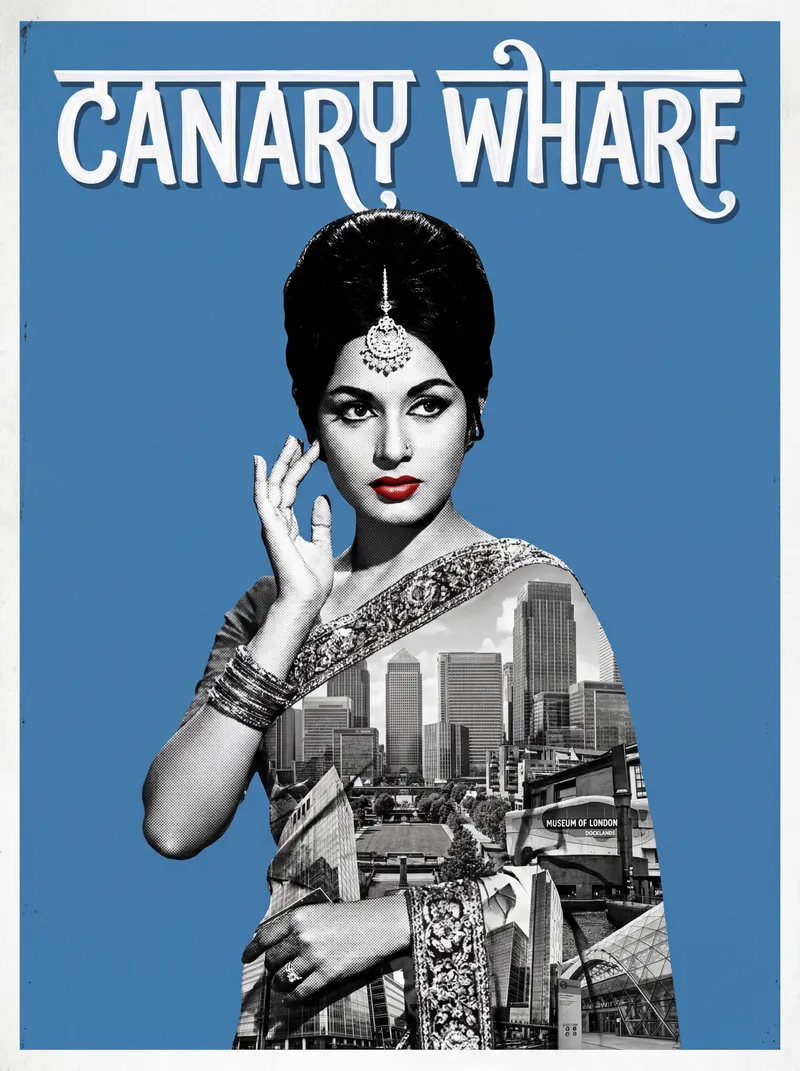
Our Canary Wharf poster — a steel-and-glass basilica.
7. Crystal Palace
Crystal Palace is the strange one — a great 1854 Italianate station building that was meant to serve the original Crystal Palace before it burned down in 1936. The station kept going. Brick tower, a half-empty grand entrance, steep parkland behind it. Our Crystal Palace poster plays up the romance of a station whose main attraction is no longer there.
8. Earl's Court
The art deco glass-and-steel facade at Earl's Court (1937) is one of the most photographed station fronts in west London — that distinctive bullnose canopy, the white-tile lettering, the original Underground roundel still bolted to the corner. Our Earl's Court poster keeps the deco geometry and warms it with the saturated palette that Bombay's Eros and Regal cinemas used in the same era.
9. Oxford Circus
Leslie Green's 1906 oxblood-tile facade still survives at Oxford Circus, half-hidden under the Regent Street arcades. Underground, the cross-passages and curved platforms feel like a particularly cinematic film set, especially around 5pm on a Friday. Our Oxford Circus poster keeps the oxblood tile and the chaos of Regent Street commerce in the same frame.
10. Piccadilly Circus
Charles Holden's 1928 circular booking hall at Piccadilly Circus is a piece of design history that doesn't get the credit it deserves. Bronze handrails, travertine walls, recessed lighting — the whole place is a 1920s hotel lobby pretending to be a Tube station. Our Piccadilly Circus poster takes the surface chaos (Eros, the LED hoardings, the late-night crowds) and runs it through a Hindi cinema poster lens.
11. Charing Cross
The 1864 Eleanor Cross replica outside Charing Cross is London's original zero-mile point, and the station hotel above is one of Sir John Hawkshaw's better Victorian flexes. Down on the Northern line platforms, David Gentleman's mural runs as a long charcoal frieze of medieval masons building the original cross. Our Charing Cross poster holds the hotel facade and the cross together.
12. Westminster
Michael Hopkins's 1999 Jubilee line box at Westminster is one of the great pieces of underground architecture in the city — exposed concrete, raw steel, escalators that drop you 30 metres under the Houses of Parliament. Above ground, it's the most photographed corner in London. Our Westminster poster holds Big Ben, the Abbey, and the river in a single composition.
How to build a gallery wall from these
Three ways to group them. By line — pick four stations from the same Underground line and run them as a horizontal row above a sofa (the Bakerloo set of Baker Street, Oxford Circus, Piccadilly Circus, and Charing Cross hangs particularly well). By era — put Victorian builds like King's Cross, Paddington, Baker Street, and Farringdon on one wall, and twentieth-century architecture like Canary Wharf, Westminster, Piccadilly Circus, and Earl's Court on another. Or by your own daily walk — the stations you actually use, in the order you used to use them, framed in the hallway. We unpack more of these arrangements in our tube line collection guide and our London wall art piece.
Pro tip: If you're mixing framed and unframed prints on the same wall, keep the frame colour consistent (all wood or all black) and let the unframed prints carry the contrast. Three framed plus two unframed in a 3-2 grid reads cleaner than five framed in a row.
The wider London set
We've covered the headline twelve here, but the full London collection runs across 56 stations and landmarks, including Camden Town, Brixton, Notting Hill Gate, and Battersea Power Station. For the broader Bollywood-meets-Tube context, our 10 most Bollywood tube stations piece is a good next read, and the Covent Garden deep dive covers the West End end of the network.
Which London station has the most beautiful architecture?
It depends on the period you like. For Victorian engineering, King's Cross and Paddington are unmatched. For art deco, Earl's Court's 1937 facade and Charles Holden's 1928 Piccadilly Circus booking hall are the two to see. For modern architecture, Norman Foster's Canary Wharf and Michael Hopkins's Westminster on the Jubilee line are the showstoppers.
Can you buy posters of London Tube stations?
Yes — we make Bollywood-style cinema posters for 56 London stations and landmarks, including all twelve in this guide. Prints come in three sizes (8×12", 16×24", 24×36") and you can add a wooden or black frame on the two smaller sizes. Browse the full set at spicyeditions.com/posters/london.
Which Tube line has the best stations for design lovers?
The Jubilee line if you like modern architecture — Westminster, Canary Wharf, North Greenwich, and Bermondsey were all rebuilt as showcases for the 1999 extension. The Piccadilly line if you prefer Charles Holden's interwar work. The Metropolitan line if you want Victorian iron and brick, with Baker Street and Farringdon as the headline acts.