
Western movie posters use shadows and silhouettes to create mood — Bollywood posters throw every colour in the box at you and dare you not to look.
The Hand-Painted Origins
Before digital printing, Bollywood posters were painted by hand. Studios in Mumbai employed artists — many of them trained sign painters — to create massive cinema hoardings, sometimes six storeys tall. These weren't subtle watercolours. They were designed to stop traffic. Literally. A 40-foot poster of Amitabh Bachchan glaring down at you from a building in Dadar? You're looking.
The artists worked fast, often painting entire hoardings in days. They used house paint — the same stuff you'd use on your front door — because it was cheap, durable, and came in screaming colours. Subtlety wasn't the brief. Visibility was.
Colour as Communication
In Indian visual culture, colour carries meaning that goes back thousands of years. Red means love and marriage. Saffron means purity and courage. Green means new beginnings. When a Bollywood poster artist chose a background colour, they weren't picking what looked nice — they were telling you what kind of film this was before you'd read a single word.
A romance? Reds, pinks, golds. An action film? Deep blues, blacks, with flashes of orange fire. A comedy? Every colour at once, as loud as possible. The palette is the genre.
Western Posters vs Bollywood Posters
Compare a typical Hollywood poster — dark background, moody lighting, the actor's face half in shadow, a single colour accent — with a Bollywood poster from the same era. The Bollywood version has three heroes, two villains, a love interest, a temple, a car chase, and a musical number, all crammed into one composition. And every element is in full, glorious colour.
Bollywood artists could absolutely do restraint — they just didn't need to. Indian cinema is maximal. The films themselves are three hours long with song breaks and costume changes. The posters match the energy. A quiet, minimalist poster for a Bollywood film would be like whispering in a nightclub.
The Golden Age: 1950s to 1980s
The golden age of hand-painted Bollywood posters runs from roughly the 1950s through the 1980s. This is when the style crystallised: bold outlines, saturated fills, dramatic poses, and that unmistakable mix of realism and fantasy. Artists like M.F. Husain (yes, the painter) actually designed Bollywood posters. So did thousands of anonymous artists whose work papered the walls of every cinema hall from Mumbai to Kolkata.
By the 1990s, digital printing had started replacing hand-painted hoardings. Most of the old poster artists moved on or retired. The craft nearly disappeared — but the aesthetic didn't. It's been absorbed into graphic design, street art, fashion, and (yes) AI-generated poster art.
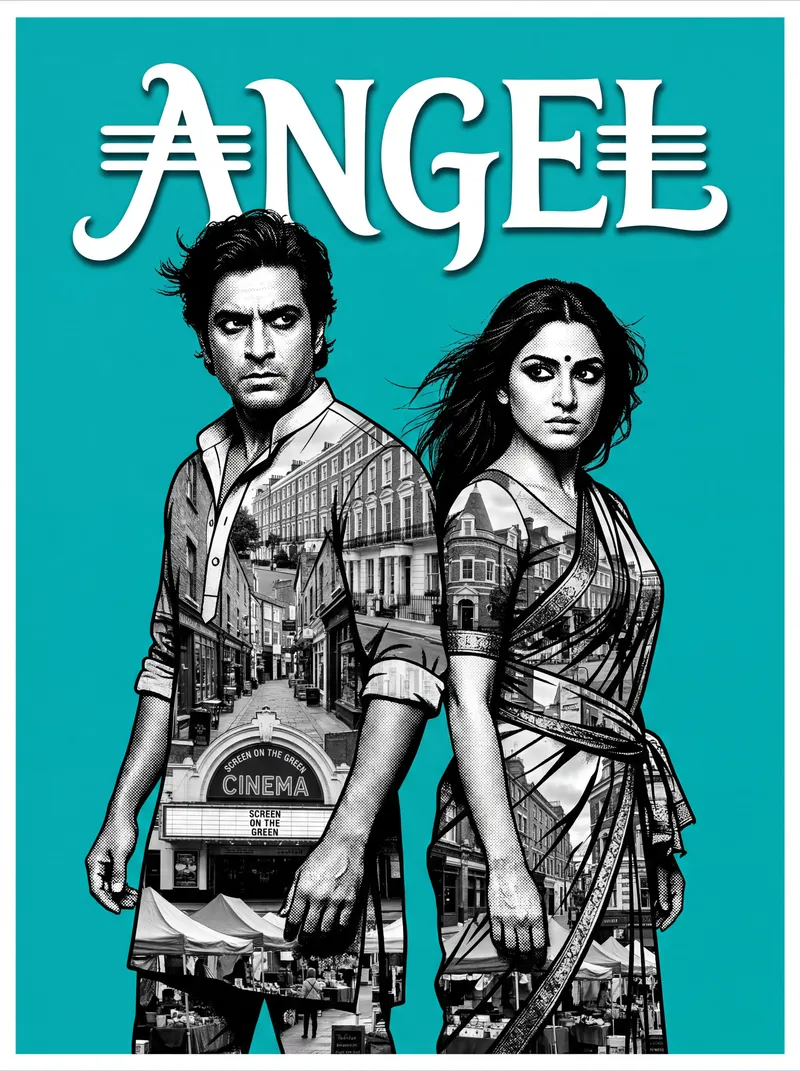
Our Angel poster — the Bollywood palette applied to Islington.
Why It Works on Your Wall
Bollywood poster art is designed to grab attention in chaotic environments — busy Mumbai streets, crowded cinema lobbies, market squares. That same visual punch translates perfectly to a living room wall. Against neutral paint (the magnolia that every UK rental comes with), a Bollywood-style poster is an instant focal point.
Our posters take this aesthetic and apply it to London tube stations and UK cities. The colour palette, the dramatic composition, the sense of spectacle — it's all there. But instead of a film star, you're looking at Shoreditch or King's Cross or Edinburgh, reimagined through a Bollywood lens.
Pro Tip: If you want to see surviving hand-painted Bollywood poster art in person, the V&A Museum in London has a collection. The Cinema Museum in Kennington also holds original Indian film posters from the golden age.
From Mumbai Hoardings to Your Flat
The journey from hand-painted cinema hoardings in 1960s Mumbai to AI-generated location posters in 2026 London is a weird and wonderful one. The tools have changed completely. But the philosophy hasn't: make it bold, make it colourful, make it impossible to ignore. That's what we do at SpicyEditions, and it's what those Mumbai poster artists were doing 70 years ago with house paint and brushes the size of brooms.
Why are Bollywood posters so much more colourful than Western movie posters?
Bollywood posters evolved from a tradition of hand-painted cinema hoardings designed to grab attention on busy Indian streets. Colour carries cultural meaning in Indian art — red for love, saffron for courage — so posters use bold palettes to communicate genre and emotion at a glance. Western posters tend toward mood and atmosphere; Bollywood posters go for maximum visual impact.
What was the golden age of Bollywood poster art?
The 1950s through the 1980s are considered the golden age. During this period, artists hand-painted massive cinema hoardings using house paint, developing the bold outlines, saturated colours, and dramatic compositions that define the Bollywood poster style.
Can I buy Bollywood-style posters of London locations?
SpicyEditions sells AI-generated Bollywood-style posters of 56 London tube stations and landmarks, plus 17 UK cities. They're printed on gallery-grade paper and available in three sizes, with framing options for the smaller sizes.