
The Sanskrit names sound like a tongue-twister until you spot the pattern — most of them are just a description, an animal, or a god, with one shared word on the end.
The word every pose shares: asana
Asana means “seat” or “pose”. It's the suffix on nearly every posture's name, so once you hear it you can ignore it and read what comes before. Tadasana is tada (mountain) + asana. Bhujangasana is bhujanga (cobra) + asana. Learn that one word and half the mystery is gone, because the interesting part is always the bit in front.
The animals, sages and gods
A whole set of poses are simply named after what they look like or who they honour. Bhujangasana is the cobra rising; Adho Mukha Svanasana hides svana, the dog. Natarajasana is named for Nataraja, Shiva as the cosmic dancer, and Virabhadrasana for Virabhadra, a fierce warrior Shiva conjured from a lock of his hair. The Half Lord of the Fishes, Ardha Matsyendrasana, carries the name of the sage Matsyendra. Knowing the story behind a name has a way of making the pose stick.
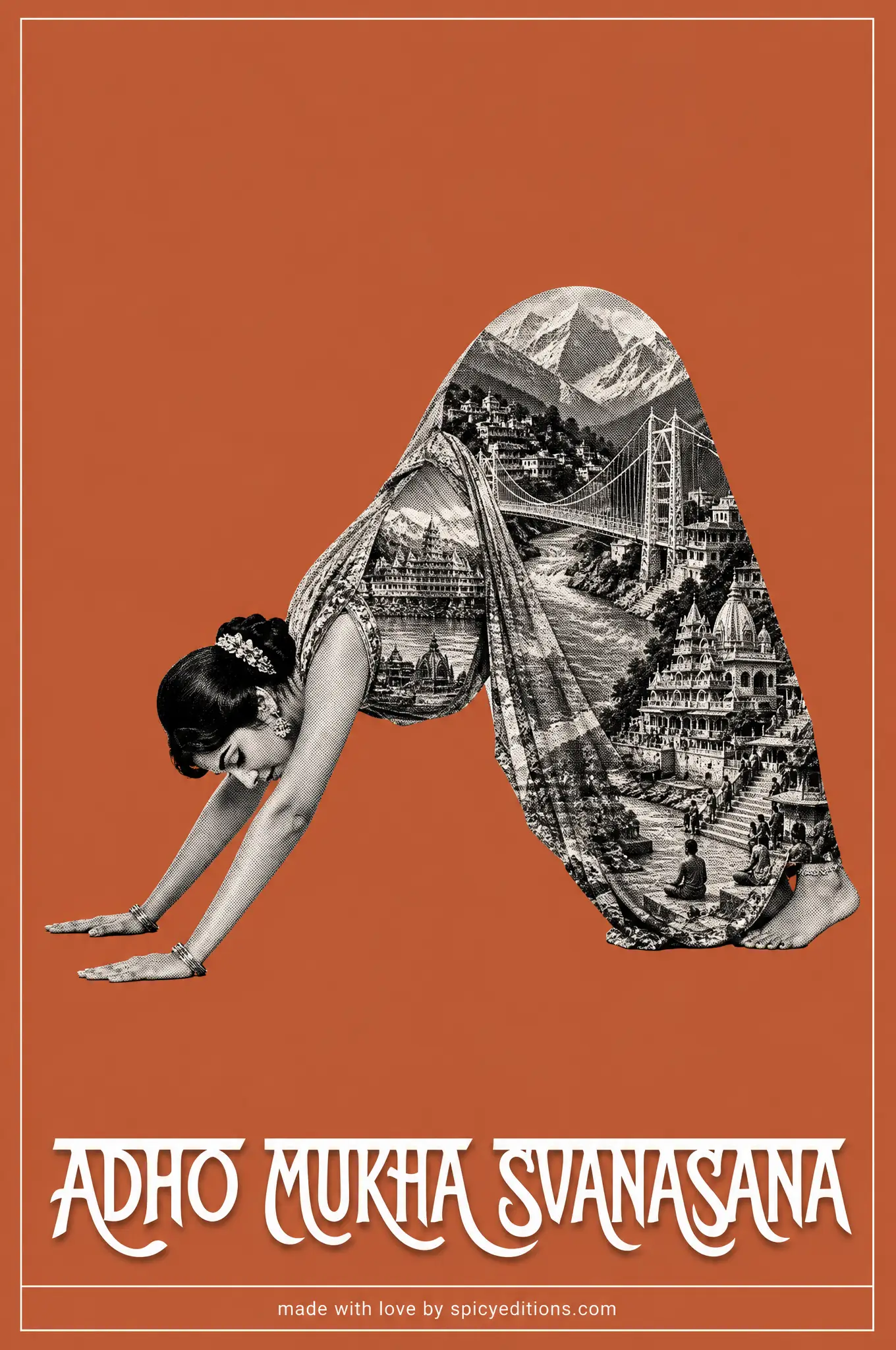
Adho Mukha Svanasana — “downward-facing dog”. Our Downward Dog print.
The direction words do the heavy lifting
A small vocabulary of modifiers tells you how a pose is oriented, and they turn up everywhere:
- Adho = downward · Urdhva = upward (Upward-Facing Dog is Urdhva Mukha Svanasana)
- Supta = reclining · Utthita = extended
- Ardha = half (Half Moon is Ardha Chandrasana)
- Parivrtta = revolved or twisted (Revolved Triangle is Parivrtta Trikonasana)
- Baddha = bound (Bound Angle is Baddha Konasana)
So Trikonasana is tri (three) + kona (angle): the three-angle pose. Add parivrtta and you've revolved it. The names are Lego — snap the parts together and you get the shape.
Numbers, sides and body parts
Two more small groups round it out. The numbers: eka (one), dwi (two), tri (three) — eka pada means “one foot” or “one leg”, which is why one-legged variations start with it. And the body parts: hasta (hand), pada (foot), janu (knee), mukha (face), parsva (side), sirsa (head). Put them together and the names read like instructions. Janu Sirsasana is knee-to-head; Parsvottanasana is an intense (uttana) side (parsva) stretch. Once you have asana, the directions, the numbers and a few body parts, you can take apart a name you've never met and make a fair guess at the pose.
Decode three and you'll get the rest
Try it. Sirsasana: sirsa (head) + asana — Headstand. Savasana: sava (corpse) + asana — the final rest. Padmasana: padma (lotus) + asana — the crossed-leg seat shaped like an open lotus. Three names, three shapes, no memorising required.
Pro Tip: Learn five roots first — asana, adho, urdhva, ardha and eka pada. They appear in dozens of poses, so five words unlock far more than five names.
Why bother?
Beyond sounding clever in class, the Sanskrit keeps a tradition that's thousands of years old attached to the shape you're making — and it's a genuinely useful memory aid, because the name often is the instruction. You don't have to pronounce it perfectly; getting the roots roughly right is plenty. Each print in our asana series carries the Sanskrit alongside the English for exactly that reason — the name and the pose, kept together.
Why do yoga poses have Sanskrit names?
Sanskrit is the classical language the yoga tradition was recorded in. The names are often plain descriptions — an animal, a direction, a sage — so they double as a record of the lineage and a clue to the pose's shape.
Do I need to learn the Sanskrit to practise yoga?
Not at all — most teachers cue in English or use both. But picking up the common roots makes classes easier to follow and the names far less intimidating.